Yamaha U1 vs U3
Height, tone, room fit, and UK pricing compared. The honest Yamaha U1 vs U3 comparison from an authorised Yorkshire dealer.
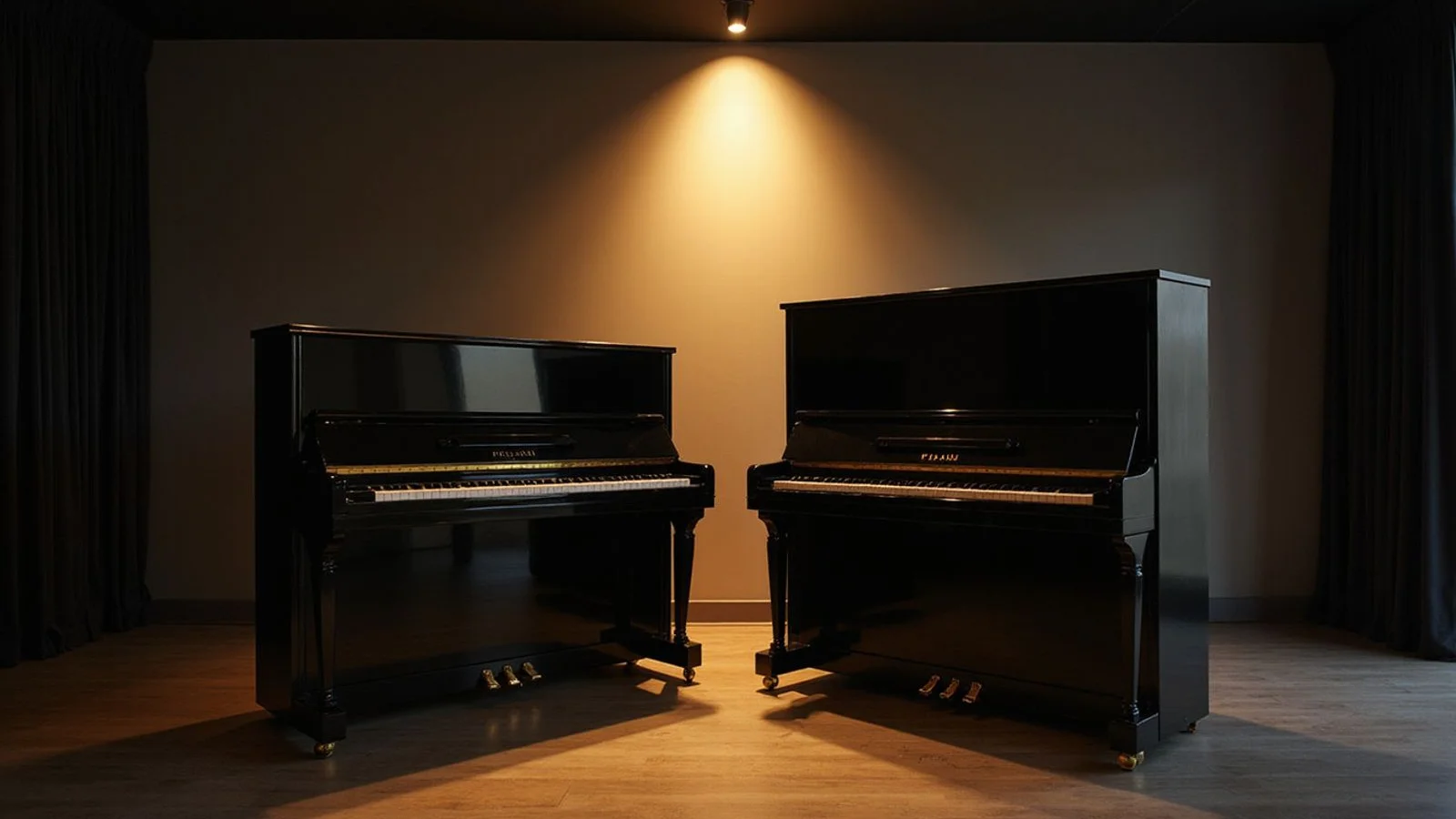
We often see clients walk into the showroom expecting a simple answer about which yamaha upright piano is best. You can read every specification sheet online, but the reality of choosing between the Yamaha U1 and Yamaha U3 comes down to how the instrument interacts with your specific room. Both models sit within our new piano range, usually on the floor ready to play. Our team has helped hundreds of musicians resolve this exact decision. Let’s look closely at the data and explore a few practical ways to decide which model belongs in your space.
Both instruments offer incredible value.
We will break down the structural differences and show you exactly how to match the right piano to your home.
Height: 10cm that changes everything
The defining difference between the Yamaha U1 and U3 is size, specifically a 10-centimetre increase in height. This extra vertical space is the foundation for every other acoustic difference you will hear. Our team always encourages buyers to look past the external cabinet and focus on the internal engineering changes. Ten extra centimetres of height means longer bass strings and a larger soundboard area.
Here are the core specifications:
- Yamaha U1: 121cm tall, 153cm wide, 61cm deep. Weight: 228kg. Soundboard: 2137 square inches. Number one bass string: 46.8 inches.
- Yamaha U3: 131cm tall, 153cm wide, 65cm deep. Weight: 246kg. Soundboard: 2369 square inches. Number one bass string: 47.5 inches.
We know these numbers might just look like technical trivia on a page. The practical takeaway is that the U3’s larger acoustic chamber physically pushes more air into the room. This structural change is the root of every other difference between the two pianos, including tone, dynamic range, and the right room choice.
Tonal character
The U1 produces a warm, beautifully balanced tone that rarely overpowers a standard living space. The U3 projects a noticeably richer, more serious sound with a significantly wider dynamic range. The registered piano technicians at our workshop have noticed a distinct difference in how these two models behave straight out of the factory.
The U1’s Consistency
The U1 has an intimate quality that works beautifully in home settings. The bass is present without being overwhelming, and the treble sings without being aggressively bright. We find that U1 models are remarkably consistent from piano to piano. They typically sit slightly on the brighter side of the tonal spectrum, making them predictable and highly liveable.
The U3’s Power and Variety
The U3 is an entirely different beast. The bass has noticeably more presence and weight due to those longer strings. Our clients love the wider dynamic range, which dictates how loud you can play before the tone distorts, and how quietly you can still produce a clear note. Push the piano and it responds with concert-level projection. This is the upright Yamaha themselves recommend for teaching studios.
A crucial insider tip is that U3 pianos offer much more tonal variation from the factory. You can actively shop for a mellow, medium, or bright U3. We strongly suggest matching the piano’s specific voice to your room’s acoustics.

Action and touch
Both models utilise Yamaha’s premium wooden action to deliver precise responsiveness. The U3 provides a subtly more substantial, grand-piano-like feel due to its longer physical keys. The professional grade 8 pianists on our staff almost always feel this difference during long practice sessions.
The extra height of the U3 cabinet creates enough space to house a taller action mechanism. The U3 features a key depth of 40.4 cm, while the U1 uses a 37.5 cm key depth. We want to highlight why this 2.9 cm difference matters for an advancing player. The longer keys provide a superior pivot point, giving you more room to control your playing and shape dynamics.
If you sit and play a U1, the touch can feel a fraction shallower compared to the deeply balanced action of the U3. Our advice is simple: if you are comparing actions, listen to the tonal response, but also focus on how your hands feel after thirty minutes. The U3 offers slightly less fatigue for serious repertoire.
| Feature | Yamaha U1 | Yamaha U3 |
|---|---|---|
| Action Mechanism | Premium Wooden | Premium Wooden |
| Key Depth | 37.5 cm | 40.4 cm |
| Touch Sensation | Responsive, slightly shallow | Deep, balanced, grand-like |
Room fit
A U1 comfortably suits almost any standard home setting without visually or acoustically overwhelming the space. A U3 requires a larger room to let its substantial sound projection breathe properly. Our primary concern is making sure you do not buy a piano that fights your room acoustics.
The U1 is essentially a home piano with proper studio-class performance. It fits nicely against living room walls and projects cleanly. The U3 wants space, not because of its physical footprint, but because of how it moves air. In a small, hard-surfaced room, a U3 can feel deafening. In a medium-to-large room with soft furnishings, it sits beautifully.
We have a simple rule of thumb for UK properties. In a Yorkshire terrace or a modest Victorian semi, choose the U1. In a larger reception room, a music room, or a teaching studio, pick the U3.
Here are a few practical placement tips from our installation team:
- The Accompanist Factor: If you are a choral teacher or instrumental accompanist, the 121cm U1 makes it much easier to see over the top of the piano to maintain eye contact with performers. The 131cm U3 often blocks sightlines.
- The Cardboard Trick: Cut a piece of cardboard to the exact footprint of the piano. We highly recommend sliding this cutout along your floor to ensure it clears tight hallways and corners before scheduling delivery.
- Floor Matching: If you have hard wood floors and minimal furniture, source a mellow-toned piano. If you have heavy carpets and thick curtains, a brighter piano will cut through the dampening effect.
UK pricing
Expect to invest between £9,500 and £11,000 for a new Yamaha U1. A new Yamaha U3 typically ranges from £11,000 to £13,500. Our showroom team updates these figures regularly to reflect current market conditions.
Prices vary slightly depending on your chosen cabinet finish. Polished ebony is the factory standard. Satin American walnut or polished mahogany finishes require a special order and carry a small premium. We encourage buyers to factor this into their initial budget.
Approximate current UK RRP at Keys & Co. for 2026:
| Model | New Standard Finish |
|---|---|
| Yamaha U1 | £9,500 to £11,000 |
| Yamaha U3 | £11,000 to £13,500 |
For the 2026 calendar year, Yamaha occasionally runs promotional campaigns, such as a £1,000 contribution towards new U Series models. Our sales team can confirm if any manufacturer discounts are active when you make your enquiry.
Who each suits
Your ideal choice depends heavily on your specific goals as a pianist and the physical dimensions of your playing area. We find the U1 is perfect for dedicated home players, while the U3 excels for ambitious students and larger studio spaces. Let’s break down the ideal buyer profiles.
Choose the U1 if you:
- Are a serious adult amateur or a returning player.
- Have a normal-sized living room, hard floors, or shared walls.
- Want a piano that works equally well at conversation volume and concert volume.
- Need to see over the music desk to accompany singers or instrumentalists.
- Prefer warmth, consistency, and intimacy in your tone.
Choose the U3 if you:
- Are a teacher, advanced amateur, or parent of an advancing student.
- Have a larger room to let the acoustic projection breathe.
- Want maximum dynamic range and concert-level bass response in an upright format.
- Value the mechanical control provided by a 40.4 cm grand-style key depth.
- Prefer raw presence and power over intimacy.
The honest middle view
Most U1 buyers remain completely thrilled with their decision five years later. Most U3 buyers feel exactly the same way about their investment. Our experience shows that the only real mistakes happen when an instrument is mismatched to its physical environment.
A U3 placed in a small, hard room will simply sound too loud and aggressive. A U1 placed in a large teaching studio might lack the acoustic headroom needed for heavy concertos. Match the piano to the room as much as to the player, and both instruments are superb. We want you to enjoy playing your instrument every single day.
If you are comparing Yamaha against Kawai more broadly, we’ve written a dedicated Yamaha vs Kawai guide. If you are weighing which brand and level is right for you in general, come and play all of them side by side in the showroom. That is usually where the decision quietly makes itself. Contact our showroom team today to schedule your private viewing and hearing test.